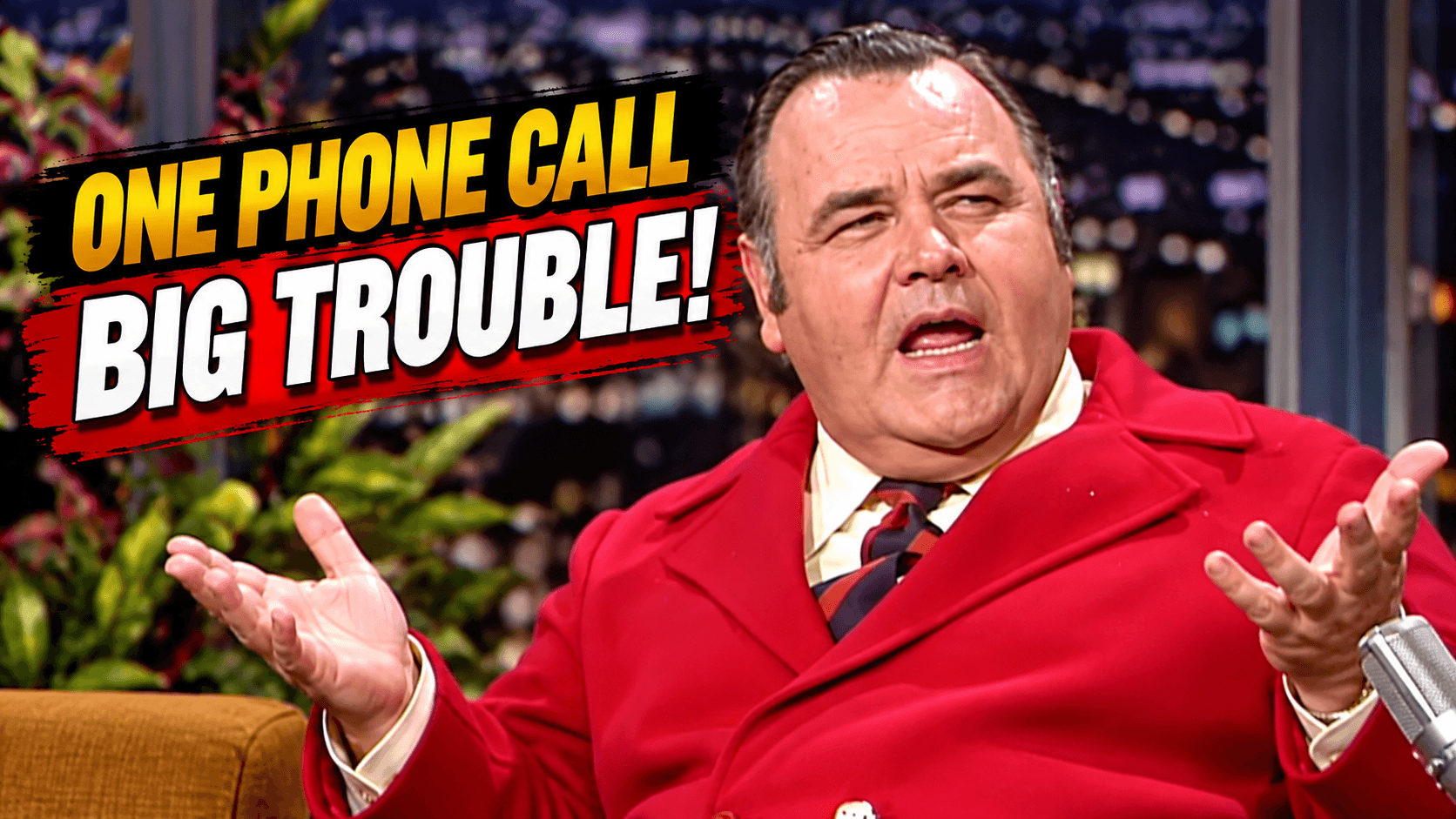
Jonathan Winters Had Johnny Carson Laughing Before the Story Even Started
ONE PHONE CALL, ONE FAKE IDENTITY, AND A COMEDIAN WHO COULDN’T STOP PLAYING CHARACTERS.

There are late-night interviews that feel carefully rehearsed.
Then there are moments when a guest walks onto the stage and the entire conversation seems to become a comedy routine.
That is exactly what makes Jonathan Winters’ appearance with Johnny Carson on The Tonight Show so memorable.
During the March 8, 1973 conversation, Winters moved effortlessly from stories about a new sweater to prank phone calls, military memories, childhood experiences, and the strange jobs he had worked before becoming a famous comedian.
What makes the interview especially entertaining is the way Winters tells his stories.
He does not simply describe something funny.
He turns ordinary memories into characters, voices, situations, and unexpected punchlines.
And Johnny Carson gives him the perfect audience.
Jonathan Winters Arrives With a Story Already Ready
The interview begins with Jonathan Winters talking about a new sweater and a pair of shoes.
Instead of simply saying he bought them, Winters explains that he got them during a sale involving items from a fire.
Even something as ordinary as clothing quickly becomes part of his comic storytelling.
It is a small example of what made Winters so distinctive.
He could take an everyday experience and make it feel like the beginning of an absurd story.
Then the conversation turns toward Johnny Carson himself.
And that is where one of Winters' old jokes comes back to life.
The Buick Phone Call Johnny Carson Never Forgot
Carson remembers a prank Winters pulled years earlier, around 1955 or 1956.
At the time, Carson was at Grand Central Station when Jonathan Winters contacted him.
Winters pretended to be someone from the advertising agency J. Walter Thompson.
The supposed offer?
Carson could become a representative for Buick and receive $2,000 along with a brand-new automobile.
For anyone receiving that kind of phone call, it would have been difficult not to get excited.
But there was a problem.
It was Jonathan Winters.
The entire opportunity was a joke.
Winters had managed to create an elaborate setup simply to give Carson a moment of excitement before revealing the truth.
It is exactly the kind of prank that explains why Winters became known for transforming ordinary conversations into elaborate comic performances.
Why Jonathan Winters Loved Pretending to Be Other People
One of the most fascinating parts of the conversation comes when Winters talks about his love of impersonating unusual characters over the telephone.
He enjoyed pretending to be elderly people and other eccentric personalities while speaking with unsuspecting strangers.
For Winters, the telephone was almost like a miniature stage.
He could invent a character, create a voice, establish a situation, and see how long the other person would continue believing the story.
And one particular prank takes that idea to another level.
The “Elwood P. Suggins” Funeral Home Prank
Winters tells Carson about calling his friend Art Lytle, who worked as a funeral director back in Ohio.
During the call, Winters adopted the voice of an elderly country man named Elwood P. Suggins.
The fictional caller had a strange problem.
He wanted to report that his brother had died the previous week.
But he did not want to bury him yet.
Instead, the body was supposedly being kept outside on the porch because the weather was cold.
The absurdity of the situation is exactly what made the story work.
Winters was not simply telling a joke.
He was creating an entire imaginary person and allowing the ridiculous situation to develop through the character's voice.
That ability to disappear into fictional personalities became one of the defining elements of his comedy.
Jonathan Winters and His Time in the Marines
The conversation eventually moves away from prank calls and toward Winters' military experience.
Johnny Carson points out that both Jonathan Winters and Ed McMahon had served in the United States Marines.
Winters' description of military life is revealing because he explains that he did not feel naturally suited to the environment.
His problem was simple.
He asked too many questions.
He was also constantly interested in performing characters and doing impressions.
For someone with Winters' personality, following strict military expectations was not always easy.
He even describes using voices and comic behavior around officers, leading people to wonder what was going on with him.
Winters ultimately served for about two and a half years before leaving the Marines.
Once again, an ordinary chapter of his life becomes another collection of unusual stories.
The Child Who Created His Own Entertainment
Long before television audiences knew Jonathan Winters, he was already creating characters and jokes.
During the interview, he remembers being around three or four years old.
As an only child, Winters found ways to entertain himself.
That detail offers an interesting glimpse into the personality behind the performer.
The imagination that later appeared on television was not something that suddenly appeared after he became famous.
It was already there when he was very young.
He had learned to create entertainment from whatever was around him.
School Was a Completely Different Story
If Winters' imagination was one of his strengths, school was apparently a much less comfortable environment.
He describes himself as a slow learner and recalls being frightened of his teacher, Miss Meder.
The blackboard was another source of anxiety.
Whenever he was called to the front of the classroom, Winters would have to look at another student and secretly copy the answer.
The story is funny because Winters tells it with the same personality that made his stage performances so memorable.
There is no complicated setup.
It is simply a childhood memory transformed into comedy.
Before Comedy Came a Long List of Strange Jobs
One of the most entertaining sections of the conversation comes when Carson asks about Winters' early working life.
Before show business, Winters worked a surprising variety of jobs.
He worked as an usher at a movie theater.
He also worked as an inspector at a Coca-Cola bottling company.
The job involved sitting and examining bottles under a light, looking for unwanted objects inside them.
That alone sounds like the setup for one of Winters' stories.
But his working history did not stop there.
He also picked apricots, dug potatoes, and husked corn.
And then came another unusual job.
Winters worked as a night cook at Yellowstone National Park, preparing food for park rangers.
Looking back at that list, it is easy to see how many different environments he experienced before becoming a professional entertainer.
Each job offered another collection of people, situations, personalities, and strange experiences.
For a comedian like Winters, those experiences could become raw material.
What Made This Johnny Carson Interview So Special?
The real attraction of this conversation is not simply the list of stories.
It is the way Jonathan Winters tells them.
He shifts voices.
He creates characters.
He exaggerates situations.
He moves between childhood memories, prank calls, military experiences, and unusual jobs without losing the audience.
And Johnny Carson knows exactly when to let Winters continue.
Their conversation feels spontaneous because Winters seems incapable of treating an ordinary memory as merely ordinary.
A sweater becomes a story.
A telephone call becomes an elaborate prank.
A military experience becomes a character sketch.
A childhood memory becomes a comedy routine.
Even a list of old jobs becomes entertaining.
That is the magic of watching an experienced comedian tell stories in a setting where he has room to simply talk.
Watch Jonathan Winters Tell the Stories Himself
Reading about these moments only gives you part of the experience.
The voices, timing, expressions, and delivery are what make Jonathan Winters' storytelling so memorable.
And that is why this interview is worth watching from beginning to end.
Stay with the conversation as Winters moves from his prank on Johnny Carson to his fictional character Elwood P. Suggins, his experiences in the Marines, his childhood memories, and the unusual jobs he held before entering show business.
The final moments are especially worth waiting for because his stories reveal just how naturally he could turn everyday experiences into comedy.
WATCH THE FULL JONATHAN WINTERS & JOHNNY CARSON INTERVIEW
Final Thoughts
Jonathan Winters' appearance on The Tonight Show is a reminder that great comedy does not always need an elaborate production.
Sometimes, all it needs is a great storyteller, a willing audience, and a strange memory from the past.
Winters had plenty of those.
From an imaginary Buick opportunity to a bizarre telephone character, from military memories to childhood experiences and unusual jobs, every part of the conversation gives viewers another glimpse into the imagination behind one of comedy's memorable performers.
If you enjoy classic comedy, old-school television interviews, and stories that become funnier with every unexpected detail, this is a conversation worth revisiting.
Tell us your favorite moment from the interview in the comments!